Sweet Basil

Sweet Basil has been hugely successful on Pohnpei, producing 3 cups of leaves about every four days.

Cherry Tomatoes

Trying to grow tomatoes on Pohnpei has been a struggle, but I'm making progress.

Common Herbs

Most of the traditional herbs, including parsley and oregano, have grown like weeds.

Lettuce

I've recently branched out into lettuce-growing and found unexpected success.

Lavender

A plant that has truly surprised me is lavender, which is notoriously difficult to propagate from seed.

Cilantro

Though unhappy with Pohnpei's hot weather, I was able to grow cilantro with care and whip up some nice batches of fresh salsa.

Pesto Pizza

One of the benefits of having so much basil is trying new recipes, like this delicious pesto pizza.

Mint

I was lucky enough to propagate two types of mint from cuttings, though I had no success growing the plant from seed.

Showing posts with label tomato. Show all posts

Thursday, May 30, 2013

Cherokee Purple Tomatoes

An Intro to Cherokee Purple Tomatoes

Cherokee Purple Tomatoes
MY STATUS: Unsuccessful

Cherokee Purple are a variety of indeterminate beefsteak tomato, producing large round fruit with a deep purple or black coloration. Supposedly, the cultivar originated with the Cherokee tribe and were commercialized in the 1990s.  They're a perfect tomato for eating raw in salads, on sandwiches, or just on their own with a rich flavor and lots of juice. Plants take 80-90 days to mature and fruit can be as large as 12 ounces. I used seeds purchased at Home Depot in Southern California in early winter. They were kept in the fridge for about 4 months.

SUN, SUN, SUN

I feel like I've said this a lot: successful tomatoes depend on lots and lots of sun. The plants may survive in shade, but they will not produce fruit. Now that I have a clear-plastic garden shelter on our roof, my plants will get as much sun as possible.

RAIN PROTECTION

Another statement I've repeated a lot: Keep the tomatoes out of the rain. Depending on how hot and sunny it is, they may need water two or three times a week. More than that and they will develop fungal and/or bacterial infections, rot or drown. Use the four-inch soil test to determine when to water: if the soil is moist at a depth of four inches, do not water.

BUGS

After bacterial and fungal infections, pests are the next biggest threat. Many varieties of worms, beetles, mites, aphids, and whiteflies consider tomato plants scrumptious. As soon as I get a complete verified list of the pests found on Pohnpei, I'll post it on this blog. Hornworms, which are notorious for ravaging tomatoes elsewhere, don't live here. Whiteflies are the most common tomato pest on Pohnpei. So far I haven't found any complete protection. View the whiteflies post for more information.

CROSS-POLLINATION ALERT

If you're growing multiple types of tomatoes at the same time and in close proximity, they can cross-pollinate. This won't affect the current generation of plants in any way, but if you plan to gather seeds from your plants for a second generation, you could end up with some strange unintended hybrids.

CONTAINERS?

A while back I pulled up one of my tomato plants and found that its roots had pretty well filled the 6 gallon pot it was growing in. This is not a good thing. Once a plant has no more room for its roots to expand, it stops growing and won't set any more fruit. This time I'm growing my tomatoes in massive pig feed bags with about 3x the volume of the original containers.

What I Did

DAY 1 - SOWING

I planted my seeds in small biodegradable starter pots filled with store-bought garden soil--three 1/2 inch holes and a few seeds in the bottom of each. I covered the seeds, watered the soil, and put the pot in direct sun.

DAY 55 - TRANSPLANTATION

My roof-top garden shelter
I've been occupied with other things these last couple of months and haven't doted on the plants as much as before, so these guys were long over-due for transplant. If I remember right, my first batch were ready to transplant in 2-3 weeks. This pair of plants spent more than twice as long in their starter pots.

I was also trying to figure out how to build a roof-top structure that I could keep my plants (and especially my tomatoes) in, so that they'd get the maximum sun Pohnpei has to offer without being exposed to the rain and wind. I had a couple of failed experiments, but finally got a really nice "house" together that keeps things dry, will stand up to the strongest winds, and gets sun from the top and all sides all day long (provided there is sun at all).

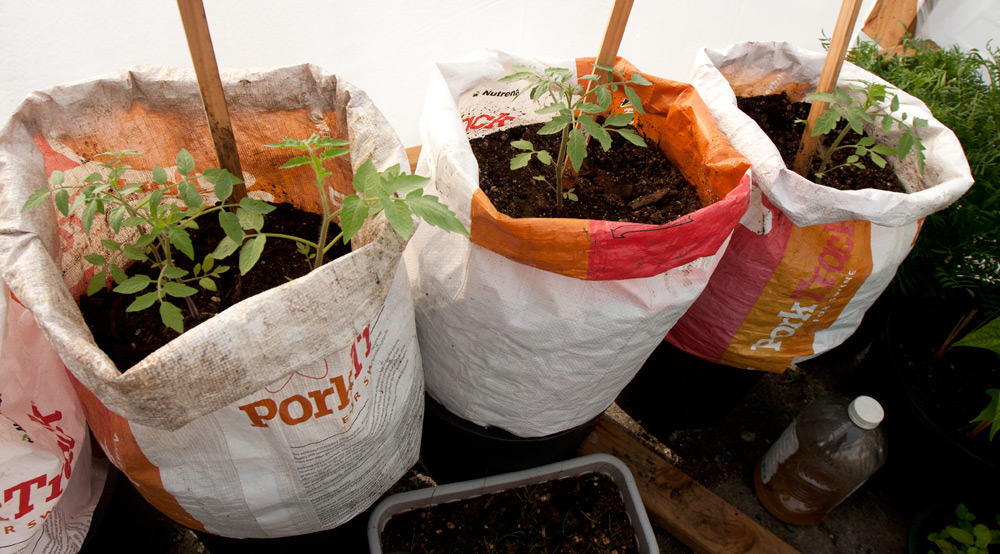
Cherokee Purple plants (right two bags) a couple of days after transplantation

Another thing I wanted to do was adjust my growing strategy for the tomatoes, since the first run failed, in part, because the plants didn't have enough room to expand their root systems. Rather than spend a bunch of money on huge containers, I collected discarded pig feed bags from people around where we live. Every local on Pohnpei has a large supply of these empty feed bags, because everyone grows pigs. The bags are huge, super heavy duty (rip-proof), and are self-supporting when filled with soil. But since I already had 6 gallon pots from the first tomato attempt, I cut the bottoms of my bags off and set them in those pots, then added my gravel layer and soil. This makes them easier to move, when necessary. Each bag took 2 1/2 bags of potting soil, and though they are not much wider than the pots are, they are triple the depth. That will give each plant 3X the vertical room to grow.  Once I got some of the sack-containers ready, I did the transplants in the manner described HERE.

DAY 62

64-day-old Cherokee Purple tomato plants

The transplants have doubled in size in the last week. Another nice thing is that I haven't found a single whitefly. I'm not sure what to attribute this absence to yet, but I'm super happy about it. I started growing marigolds a couple of months back and have a huge container that is currently flowering. I chose to grow them specifically because of their reputation for repelling insects and hoped they would similarly affect the whiteflies.

DAY 77 - TOMATO YELLOW LEAF CURL VIRUS & TERMINATION

Yellow Leaf Curl Virus on Cherokee Purple tomato plant
Over the past few days, both Cherokee Purples have began to show signs of Tomato Yellow Leaf Curl Virus, a fatal disease transmitted by whiteflies. Since no whiteflies have been observed since way back when the plants were tiny seedlings, I can only suppose that they were infected at that point and the disease takes a while to make itself apparent. Symptoms include curling, discolored, yellowish leaves with dark veins on the underside and deformation of the main stem--skinny at the bottom near the soil and about 3 to 4 times as thick near the top. Furthermore, growth has been severely retarded since the plants began to display symptoms. I'm not sure if the virus can be transmitted via physical contact with other plants, but to be safe, I am going to pull up these plants and destroy them. :(

Supersweet 100VF Hybrid Cherry Tomatoes

An Intro to Supersweet 100VF Hybrid Cherry Tomatoes

MY STATUS: Grown Successfully to Harvest  

Supersweet 100VF Hybrid Cherry Tomatoes Supersweet 100VF Hybrid are a type of round cherry tomato with a resistance to verticillium and fusarium wilt.  Like all the tomato varieties I've tried to grow here, they are indeterminate, meaning that plants will continue to produce fruit as long as the weather is sufficiently warm--a good choice for Pohnpei's endless summer temperatures. Plants can grow to a height of 4 feet and take 80-90 days to mature. Fruit are small, but cherry tomato plants tend to be more prolific than large varieties. I used Ferry-Morse Start Smart seeds purchased at Home Depot in Southern California in early winter. They were kept in the fridge for about 4 months.

SUN, SUN, SUN

I feel like I've said this a lot: successful tomatoes depend on lots and lots of sun. The plants may survive in shade, but they will not produce fruit. One thing I'm still trying to figure out is how to get my tomatoes out in the open where they can get maximum sun and still be protected from rain and wind. Right now they get about 3 hours of direct sun in the afternoon (on a sunny day), which is just not enough. I tried building a PVC structure, but that didn't stand up to the crazy gusts of wind we get here. Now I'm thinking about something constructed of metal or wood.

RAIN PROTECTION

My roof-top garden shelter
Another statement I've repeated a lot: Keep the tomatoes out of the rain. Depending on how hot and sunny it is, they may need water two or three times a week. More than that and they will develop fungal and/or bacterial infections, rot or drown. Use the four-inch soil test to determine when to water: if the soil is moist at a depth of four inches, do not water.

BUGS

After bacterial and fungal infections, pests are the next biggest threat. Many varieties of worms, beetles, mites, aphids, and whiteflies consider tomato plants scrumptious. As soon as I get a complete verified list of the pests found on Pohnpei, I'll post it on this blog. Hornworms, which are notorious for ravaging tomatoes elsewhere, don't live here. Whiteflies are the most common tomato pest on Pohnpei. So far I haven't found any complete protection. View the whiteflies post for more information.

CROSS-POLLINATION ALERT

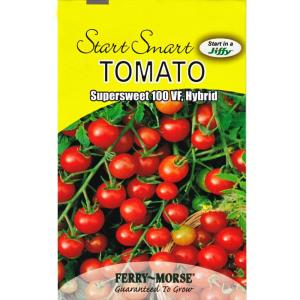
Ferry-Morse Supersweet 100VF seeds If you're growing multiple types of tomatoes at the same time and in close proximity, they can cross-pollinate. This won't affect the current generation of plants in any way, but if you plan to gather seeds from your plants for a second generation, you could end up with some strange unintended hybrids.

CONTAINERS?

A while back I pulled up one of my tomato plants and found that its roots had pretty well filled the 6 gallon pot it was growing in. This is not a good thing. Once a plant has no more room for its roots to expand, it stops growing. I will probably try larger pots this time around.

What I Did

DAY 1 - SOWING

I planted my seeds in small biodegradable starter pots filled with store-bought garden soil--three 1/2 inch holes and a few seeds in the bottom of each. I covered the seeds, watered the soil, and put the pot in direct sun. Seedlings were thinned a few days after germination to the three most robust plants. They were later thinned down to the two best plants.

DAY 62 - TRANSPLANTATION

Being busy and not playing much attention to these plants, they grew slowly and were quite overlarge by the time I got all the conditions in place for a transplant. Sixty days is a heck of a long time for tomatoes to be in starter pots, but that's okay. The garden can't be priority number one all the time.

I was also building a roof-top structure that I could keep my plants (and especially my tomatoes) in, so that they'd get the maximum sun Pohnpei has to offer without being exposed to the rain and wind. the "house" is pretty sweet and has done wonders for all the other plants. I'm crossing my fingers about the tomatoes.

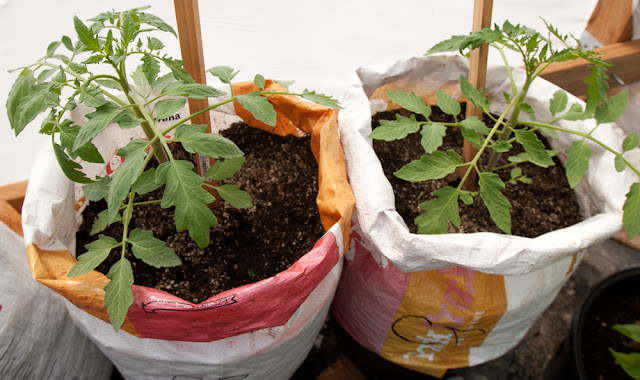
Supersweet 100VF a few days after transplantation


Another thing I wanted to do was adjust my growing strategy for the tomatoes, since the first run failed, in part, because the plants didn't have enough room to expand their root systems. Rather than spend a bunch of money on huge containers, I collected discarded pig feed bags from people around where we live. Every local on Pohnpei has a large supply of these empty feed bags, because everyone grows pigs. The bags are huge, super heavy duty (rip-proof), and are self-supporting when filled with soil. But since I already had 6 gallon pots from the first tomato attempt, I cut the bottoms of my bags off and set them in those pots, then added my gravel layer and soil. This makes them easier to move, when necessary. Each bag took 2 1/2 bags of potting soil, and though they are not much wider than the pots are, they are triple the depth. That will give each plant 3X the vertical room to grow.  Once I got some of the sack-containers ready, I did the transplants in the manner described HERE.

So far no whiteflies! If it's the marigolds, more power to them!!

DAY 64

Flowers on Super Sweet 100VF plants
The plants are loving the room, the sun, everything. Growth has been very fast. Leaves are lush and the plants look great. Even better--still no whiteflies. Not one. :)

DAY 70 - FLOWERS

Several clusters of flowers have developed and are in full bloom. I've started shaking the plants a few times a day to encourage pollination.

DAY 85 - DEVELOPING TOMATOES

Tomatoes on Super Sweet 100VF plants 85 days after sowing
I'm pretty shocked by how different these plants are from my first attempt at tomatoes. The growth has been incredibly fast. The entire summer of sunny days has certainly made a difference (even if we paid for it by baking every day). The garden shelter is a huge success. The tomatoes love it. So is the decision to plant in pig feed bags. Whiteflies continue to be absent and there have been no signs of diseases. Plants are nearing the roof, and I'll have to start training them out the side for more room. There are roughly fifty developing tomatoes on one of the plants and slightly less on the other. I've never seen so many flowers on a single tomato plant before.

Tomatoes on Super Sweet 100VF plants 85 days after sowing

DAY 107 - LOOKING GOOD

I'm on the doorstep of a harvest here. These plants have been quite amazing. They are LOADED with fruit and continue to flower like crazy. I've had to tie up many of the branches, because the weight of all the tomatoes was causing them to break. There are few fruit that are ready now, but I'd say a day or two more and I'll pick a nice batch.

Supersweet 100VF Hybrid Cherry Tomatoes on Day 107

Supersweet 100VF Hybrid Cherry Tomatoes on Day 107

DAY 110 - FIRST HARVEST


Supersweet 100VF Hybrid Cherry Tomatoes on Day 110
Today I picked my first fruit. They varied in size as you can see from the picture. All were sweet and delicious -- absolutely perfect. Another few days and I'll get a real harvest.

DAY 114 - ROLLING ALONG

Supersweet 100VF Hybrid Cherry Tomatoes on Day 114
I'm harvesting now a little bit almost every day. A few fruit here and few there. The BIG ONE is still ahead. The plants continue to put out flowers and fruit all over the place. It's actually crazy how many fruit appear on each branch. The twice daily blossom shaking must be doing the trick. I'm sure the unseasonably dry weather is helping, too.

DAY 128 - EVEN BETTER

Things continue to pick up every day.

DAY 140 - MASSIVE SUCCESS

My plants have now reached their peak and I'm getting around 30-50 sweet, delicious tomatoes per week from each plant. They're fantastic! I suppose they can't go on like this forever. I'd expect that things will start to slow down relatively soon, so 3 months is probably about the longest you can string plants like this out in Pohnpei's climate.

DAY 180 - DONE

It's been just over two solid months of fruit and now things have dropped off as I predicted. There are still some ripening fruit, but I don't see any new flowers and the main stem is becoming woody -- all signs that these plants have run their course.

San Marzano Tomatoes

An Intro to San Marzano Tomatoes

MY STATUS: Grown Successfully to Harvest  

San Marzano Tomatoes
San Marzano are a type of plum tomato with an elongated body and firm flesh used primarily for making tomato paste for sauces.  They're similar to Roma tomatoes but are said to have a stronger, sweeter taste. Because they aren't as tender or juicy as the large beefsteak tomatoes, they aren't as desirable for salads and sandwiches. Like all the tomato varieties I've tried to grow here, they are indeterminate, meaning that plants will continue to produce fruit as long as the weather is sufficiently warm--a good choice for Pohnpei's endless summer temperatures. Plants can grow to a height of 6 feet and take 80-90 days to mature. Fruit are about 4 ounces. I used Martha Stewart Living seeds purchased at Home Depot in Southern California in early winter. They were kept in the fridge for about 4 months.

SUN, SUN, SUN

I feel like I've said this a lot: successful tomatoes depend on lots and lots of sun. The plants may survive in shade, but they will not produce fruit. One thing I'm still trying to figure out is how to get my tomatoes out in the open where they can get maximum sun and still be protected from rain and wind. Right now they get about 3 hours of direct sun in the afternoon (on a sunny day), which is just not enough. I tried building a PVC structure, but that didn't stand up to the crazy gusts of wind we get here. Now I'm thinking about something constructed of metal or wood.

RAIN PROTECTION

Another statement I've repeated a lot: Keep the tomatoes out of the rain. Depending on how hot and sunny it is, they may need water two or three times a week. More than that and they will develop fungal and/or bacterial infections, rot or drown. Use the four-inch soil test to determine when to water: if the soil is moist at a depth of four inches, do not water.

BUGS

After bacterial and fungal infections, pests are the next biggest threat. Many varieties of worms, beetles, mites, aphids, and whiteflies consider tomato plants scrumptious. As soon as I get a complete verified list of the pests found on Pohnpei, I'll post it on this blog. Hornworms, which are notorious for ravaging tomatoes elsewhere, don't live here. Whiteflies are the most common tomato pest on Pohnpei. So far I haven't found any complete protection. View the whiteflies post for more information.

CROSS-POLLINATION ALERT

If you're growing multiple types of tomatoes at the same time and in close proximity, they can cross-pollinate. This won't affect the current generation of plants in any way, but if you plan to gather seeds from your plants for a second generation, you could end up with some strange unintended hybrids.

CONTAINERS?

My primary worry with the San Marzanos was that the containers won't give them enough room to grow, but with the pig feed bag method, things should be excellent.

What I Did

DAY 1 - SOWING

I planted my seeds in small biodegradable starter pots filled with store-bought garden soil--three 1/2 inch holes and a few seeds in the bottom of each. I covered the seeds, watered the soil, and put the pot in direct sun. A few days after germination, I thinned the seedlings to three. About a week later, I thinned them down to a single plant.

DAY 62 - TRANSPLANTATION

My roof-top garden shelter
Being busy and not playing much attention to these plants, they grew slowly and were quite overlarge by the time I got all the conditions in place for a transplant. Sixty days is a heck of a long time for tomatoes to be in starter pots, but that's okay. The garden can't be priority number one all the time.

I was also building a roof-top structure that I could keep my plants (and especially my tomatoes) in, so that they'd get the maximum sun Pohnpei has to offer without being exposed to the rain and wind. the "house" is pretty sweet and has done wonders for all the other plants. I'm crossing my fingers about the tomatoes.

Recently transplanted San Marzano tomato plant (left bag)


Another thing I wanted to do was adjust my growing strategy for the tomatoes, since the first run failed, in part, because the plants didn't have enough room to expand their root systems. Rather than spend a bunch of money on huge containers, I collected discarded pig feed bags from people around where we live. Every local on Pohnpei has a large supply of these empty feed bags, because everyone grows pigs. The bags are huge, super heavy duty (rip-proof), and are self-supporting when filled with soil. But since I already had 6 gallon pots from the first tomato attempt, I cut the bottoms of my bags off and set them in those pots, then added my gravel layer and soil. This makes them easier to move, when necessary. Each bag took 2 1/2 bags of potting soil, and though they are not much wider than the pots are, they are triple the depth. That will give each plant 3X the vertical room to grow.  Once I got some of the sack-containers ready, I did the transplants in the manner described HERE.

So far no whiteflies! If it's the marigolds, more power to them!!

DAY 64

64-day-old San Marzano plant (2 days after transplantation
Boy did these plants want to be transplanted! In the two days since I put the San Marzano in the bag, it has tripled in size. It's loving the room, the sun, everything. Even better--still no whiteflies. Not one. :)

DAY 77 - FLOWERS

Three clusters of flowers have developed and just bloomed today. I've started shaking the plants a few times a day to encourage pollination.

DAY 85 (8/22) - DEVELOPING TOMATOES

This plant is developing roughly three times as fast as the plants in my first tomato run. Certainly the garden shelter has done wonders and a long spell of sunny weather can't have hurt. I still have not observed a single whitefly on any of the five tomato plants I currently have. Leaves look lush and healthy, and the plant is already more than two feet tall. A few of the flowers have dried up and small developing tomatoes are visible. This is pretty amazing, considering I just planted the things about 20 days ago. The plant also seems to have avoided the Yellow Leaf Curl Virus that did in my two Cherokee Purples.

Developing fruit on 95-day-old San Marzano plant

Sunday, May 5, 2013

What Can Happen If You Don't Stake Your Tomatoes Properly

Cherry tomato plant with broken main stem
Here's an example of the damage that can result if you don't stake your tomatoes properly or expose them to too much wind. This cherry tomato plant snapped off in the middle of the main stem, just above where the stake ended. Unfortunately, the plant was currently fruiting and had about 20 infant tomatoes on the top, so I lost a harvest.

THE LESSON

  • Stakes should be taller than the plant will ever grow. This plant outgrew the stake and I didn't bother to put in a new one.
  • Stakes should be installed as deeply as possible.
  • Two stakes are better than one.
  • The more places the stem is tied to the stake(s), the better.
  • Tomatoes shouldn't be in a place that is completely unprotected from wind (like the open roof).

IF THIS HAPPENS TO YOU

Don't give up hope. Tomato plants are able to recover quite well from this sort of injury. Though the main stem will not regrow from the breaking point, the plant will produce new branches that will take the place of the growing tip. Normally these are called suckers. They grow at the intersection of the main stem and a major branch. Usually you snip them off as soon as they appear. But, if your main stem is severed, you can let one of these suckers grow to take its place.

GRAFT & TAPE

If your stem is just broken, but not completely detached, you can tape it back in place and the two parts will eventually fuse back together just like a broken bone.

PLANT THE BROKEN BRANCH / STEM

Broken branches and large sections of stem can also be replanted. They will root in a short time and reestablish themselves. This is actually the process known as "cloning" and it can be done to create new plants rather than growing from seed.

Tuesday, April 16, 2013

Recommended Tomato Short-List

Tomato Recommendations by Color

I've created a short-list of indeterminate tomato cultivars that are good bets for growing on Pohnpei. With the exception of the last four, all of the varieties on this list are disease-resistant. I also selected types that tend to be small to medium, as larger tomatoes take longer to develop and are thus more prone to problems.

RED

Clermon F1 Clermon (F1)
Round medium-sized red tomato with resistance to Tobacco Mosaic Virus, Fusarium Crown and Root Rot, Fusarium Wilt 1 & 2, Leaf Molds A-E, and Verticillium Wilt.
70 days to maturity.
15 seeds = $10.00

Geronimo F1Geronimo (F1)
Round medium to large-sized red tomato with resistance to Tobacco Mosaic Virus, Fusarium Wilt 1 & 2, Leaf Molds A-E, and Verticillium Wilt.
78 days to maturity.
15 seeds = $10.00

Granadero F1Granadero (F1)
Oblong medium-sized red sauce tomato with resistance to Tobacco Mosaic Virus, Fusarium Wilt 1 & 2, Powdery Mildew, Nematodes, Tomato Spotted Wilt Virus, and Verticillium Wilt.
75 days to maturity.
15 seeds = $6.00

San Marzano 168 F1San Marzano 168 (F1)
Oblong medium-sized red sauce tomato with resistance to Fusarium Wilt 1 & 2 and Verticillium Wilt.
78 days to maturity.
40 seeds = $4.00

PINK

Sunpeach F1Sunpeach (F1)
Deep pink cherry tomato with resistance to Tobacco Mosaic Virus, Leaf Molds A-E, and Fusarium Wilt 1.
60 days to maturity.
40 seeds = $5.00

Chiquita F1Chiquita (F1)
Small oblong-shaped rose-pink tomato with resistance to Fusarium Wilt 1.
63 days to maturity.
40 seeds = $6.00

YELLOW / ORANGE

Yellow Mini F1Yellow Mini (F1)
Sweet yellow cherry tomato with resistance to Tobacco Mosaic Virus and Fusarium Wilt 1.
57 days to maturity.
40 seeds = $6.00


Golden Sweet F1Golden Sweet (F1)
Small oblong yellow tomato with resistance to Leaf Mold A-E, Late Blight, and Fusarium Wilt 1.
60 days to maturity.


Beorange F1Beorange (F1)
Round medium-sized yellow tomato with resistance to Tobacco Mosaic Virus, Leaf Mold A-E, Verticillium Wilt, Fusarium Wilt 1 & 2, and Fusarium Crown and Root Rot.
75 days to maturity.
15 seeds = $20.00

Sun Gold F1Sun Gold (F1)
Sweet tangerine-orange cherry tomato with resistance to Tobacco Mosaic Virus and Fusarium Wilt 1.
57 days to maturity.
40 seeds = $4.00

Golden Rave F1Golden Rave (F1)
Small oblong yellow tomato with resistance to Fusarium Wilt 1.
67 days to maturity.
15 seeds = $4.00

GREEN

Green Zebra OGGreen Zebra (OG)
Medium light and dark green-striped tomato. No disease resistance.
72 days to maturity.
40 seeds = $4.00


Aunt Ruby's German GreenAunt Ruby's German Green
Medium light green tomato sometimes marbled with pink. No disease resistance.
85 days to maturity.
25 seeds = $2.50

PURPLE / BROWN

Black Krim OGBlack Krim (OG)
Medium to large deep brown/purple tomato. No disease resistance.
80 days to maturity.
40 seeds = $4.00


Cherokee Purple OGCherokee Purple (OG)
Medium to large deep brown/purple tomato. No disease resistance.
72 days to maturity.
40 seeds = $4.00

Monday, April 15, 2013

Powdery Mildew-Resistant Tomato Cultivars

The following tomato varieties have been bred to be resistant to powdery mildew, a fungal disease that affects tomatoes and many other plants. The primary symptom is powdery white spots on the leaves that get progressively bigger. The disease usually begins on the lower branches and moves up. The fungus likes cool, humid conditions and is more likely to become a problem during cloudy weather. The best way to prevent the occurrence of this disease is by planting cultivars that are resistant to it. I've listed four tomato varieties here.

Geronimo F1
Granadero F1
Massada F1
Striped Stuffer

Leaf Mold-Resistant Tomato Cultivars

Leaf mold on tomato plant The following tomato varieties have been bred to be resistant to Leaf Mold, a common tomato plant disease.

Agatha
Apero F1
Bigdena
Favorita F1
First Blish
Geronimo F1
Golden Sweet F1
Growdena
Massada F1
Olivade F1
Panzer
Rapsodie
Sapho F1
Sweet Hearts
Toronjina F1
Trust

Verticillium-Resistant Tomato Cultivars

Big Beef F1 Though not entirely immune, the following tomato varieties have been bred to be resistant to the verticillium fungus. Pictured: Big Beef F1.

Abe Lincoln
Abuelo
Ace 55
Agatha
Agriset 8279 F1
Amelia VR F1
Andino NUN3149
Angelina F1
Applause
Applegate F1
Arbason
Ariset 334
Atomic
Bambino F1
Basket Vee
Beaufort F1
Beefmaster
Better Boy F1
Better Bush
BHN-1021 F1
BHN-189
BHN-268
BHN-410
BHN-444
BHN-543
BHN-585
BHN-586
BHN-589
BHN-602
BHN-640
BHN-762
BHN-768
BHN-783
BHN-826 F1
BHN-871
BHN-876
BHN-882
BHN-901
BHN-961
BHN-968
Big Beef F1
Big Bite
Biltmore
Bobcat
Bush Celebrity
Bush Champion II
Bush Early Girl
Bush Goliath
Cabernet F1
Cambell's 33
Capaya
Carnival
Caruso
Celebrity F1
Celebrity Supreme
Champion
Champion II
Cherry Blossom
Classica
Clermon
Cluster Goliath
Cobra F1
Cordova F1
Corona Ps
Cortez
Country Tast
Crista F1
Dafel
Debut
Defiant PhR F1
Delicious
Early Cherry
Early Girl F1
Early Goliath
El Cid F1
El Patron
El Senor
Emperador F1
Empire
Estiva
Fabulous
Fantastic F1
Fantom
Finishline
First Blish
First Pik
Five Star Grape F1
Floralina
Florida 47 F1
Follia
Geronimo F1
Giant Valentine
Glamour
Gold Nugget
Golden Girl
Golden Honey Bunch
Golden Milano
Granadero F1
Grandeur
Grandma's Garden
Grandma's Pick
Granny Smith
Gremlin F1
Growdena
Halcon
Hard Rock
Health Kick
Heartland
Heinz 1439 VFA
Heinz 2653
Hermosa HM 8849
Homesweet
Husky Cherry Red
Husky Red F1
Hy-Beef 9904
Hybrid 46
Impacto
Incas
Italian Goliath
Jelly Bean Red
Jelly Bean Yellow
Jet Star F1
Jetsetter
Joker
Jolly Elf F1
JTO-99197
Jumbo VF
Kada
Keepsake
Lemon Boy
Linda
Lunchbox
Manitoba
Margherita
Marglobe Select VFA
Margo
Mariana
Marmande
Marmara
Massada F1
Maxifort
Medfo
Mini Charm
MiReina
Miroma
Monica F1
Moreton
Mr. Ugly
Mt. Crest
Mt. Delight
Mt. Fresh Plus F1
Mt. Glory
Mt. Magic
Mt. Pride
Mt. Spring
Murie
NC 50-7
New Girl F1
Northern Delight
Ofri
Old Fashioned Goliath
Olivade
Orange Sunshine
Oregon Spring
P418 APT 533
Panzer
Paragon
Park's Beefy Boy
Park's Whopper
Pear Goliath
Picus
Pik Red F1
Pik Rite
Pilavy
Pilgrim
Pink Brandymaster
Pink Girl F1
Pitenza
Plum Crimson F1
Plum Regal
Polbig F1
Primo Red F1
Puebla
Qualit 21
Qualit 23 F1
Rapsodie
Ravello
Reba
Red Brandymaster
Red Candy
Red Defender
Red Delight
Red Pride
Redline
RFT 6153
Rocky Top
Roma
Royal Mountie
Rutgers 39
Sahel
Samurai F1
San Marzano 168 F1
Sapho F1
Scarlet Red F1
Scout
Show Girl
Siletz
Silverado F1
Small Fry
Smarty
Solar Fire F1
Solar Set R
Sophya F1
Spitfire
Springfield
STM 0225
STM 5811
Sun Gold F1
Sun King
Sun Leaper
Sun Pride
Sunbeam
Sunbrite F1
Sunchief
Sunguard
Sunkist F1
Sunmaster
Sunoma
Sunray
Sunrise
Sunsation F1
Sunshine
Sunstart
Super Bush
Super Marzano F1
Super Sioux
Super Sweet 100
Supersonic F1
Supersteak
Sweet Chelsea F1
Talladega
Tolsoi
Tomande
Tomosa
Torbay
Torero F1
Tormenta
Toro F1
Tough Boy 8 F1
Tough Boy 93 F1
Tribeca
Trinity F1
Tropic Boy F1
Trust
TY-40 F1
TY-75 F1
Ultimate Opener
Ultra Girl
Valley Girl F1
Valleycat
Veeroma
Veronica
Victoria Supreme
Viva Italia F1
Window Box Roma
Wolverine
Yellow Brandymaster
Yellow Pear

Saturday, April 13, 2013

Fusarium-Resistant Tomato Cultivars

Golden Rave F1Though not immune, the following tomato varieties have been bred to be resistant to the Fusarium fungus, giving them an edge in Pohnpei's hot, ultra-humid climate. Pictured: Golden Rave F1

Abe Lincoln
Ace 55
Agatha
Apero F1
Arbason F1
Bambino F1
Basket Vee
Beefmaster
Better Bush
Big Girl
Bush Goliath
Caruso
Celebrity
Champion
Conestoga F1
Cupid F1
Dafel
Emperador F1
Fantastic F1
Geronimo F1
Giant Valentine
Golden Milano Cherry
Golden Rave F1
Granny Smith
Grapette Hybrid
Hardrock
Heinz
Homestead
Imperial
Jet Star F1
Jubilee
Jumbo VF
Lemon Boy
Lunch Box
Manalucie FST
Margherita
Marglobe Select VFA
Marion
Marmande
Marmara
Monarca
Montesino F1
Mountain Belle
Mountain Delight
Mountain Gold
Mt. Pride
Olivade F1
Palenque
Picus
Pitenza
Polbig F1
Red Candy
Roma
Sapho F1
Smarty
Sun Cherry Extra
Sun King
Sunkist F1
Sunny Goliath
Sunray
Sunrise
Super Fantastic
Super Sioux
Super Sweet 100
Supersonic F1
Supersteak
Suzanne F1
Sweet Chelsea F1
Sweet Hearts
Sweet Million
Sweet Mojo
Sweet Orange
Toronjina F1
Ultimate Opener
Ultra Girl
Veeroma
Viva Italia

Tuesday, April 2, 2013

Aunt Ruby's German Green Tomatoes

An Intro to Aunt Ruby's German Green Tomatoes

MY STATUS: Grown Successfully to Harvest 

The German Green cultivar is a recent addition to the heirloom tomatoes, developed by Ruby Arnold of Greeneville, Tennessee, in the 1990s. It is distinctive for its pale green coloration when ripe, sometimes with darker green striations on the shoulders. It's another indeterminate type of tomato, so it will keep bearing as long as the weather is sufficiently warm--well-suited for an unvarying tropical climate. German Green tomatoes are the largest green "beefsteak" (they can get as big as 1 pound). There are said to have a slightly "spicy" or "fruity" flavor. Plants can grow as tall as 4 feet (although on Pohnpei, it would make sense to keep the plants smaller so that they can focus their energy on fruit production) and take 80-90 days to mature. I used Ferry-Morse seeds purchased at Home Depot in Southern California in early winter and sowed them in starter pots about one month later.

Aunt Ruby's German Green Tomato seeds Pretty much everything about this tomato is the same as the others I've talked about on this blog. It needs lots of sun and heat to set fruit, should be protected from rain and planted in a well-draining soil mix, and is vulnerable to the same pests as any other tomato. See Black Krim description for more detailed information. I also did everything with these plants the same as I did with the Black Krim variety, so the notes below are identical.

CROSS-POLLINATION ALERT

If you're growing multiple types of tomatoes at the same time and in close proximity, they can cross-pollinate. This won't affect the current generation of plants in any way, but if you plan to gather seeds from your plants for a second generation, you could end up with some strange unintended hybrids.

What I Did

DAY 1 - SOWING

German Green seedlings
I planted my seeds in small biodegradable starter pots filled with store-bought garden soil--a 1/2 inch hole in the middle and a few seeds in the bottom. I covered the seeds and gave the pot 1/2 medicine cup of water a couple of times during the day, keeping the soil moist but not soggy.


DAY 5 - GERMINATION

Several seedlings shot up on the fifth morning after planting (right).

DAY 8 - THINNING

3-day-old German Green seedlings
The seedlings have reached a height of about 2 inches (left) with thick, hairy stems. I pulled out all but the two tallest, most robust seedlings in each pot.

DAY 13 - APPLICATION OF FISH EMULSION

I've begun watering with a solution of Alaska Fish Emulsion. The seedlings are looking happy.


German Green seedlings 25 days after seeding
DAY 25 - TRANSPLANTATION

I unintentionally let my seedlings go a lot longer than I should have without planting (left). I got occupied with other things and they stayed in their starter pots until I noticed that they seemed to be showing the effects of crowding. I hurried to prepare my pots for planting.

SOIL PREPARATION
:
  • I used a 5.5 gallon pot for each tomato plant to give the roots plenty of room to expand.
  • First, I poured in a 2-inch layer of medium basalt gravel (rinsed). This layer and the following one are there to help the soil stay drained, so the roots of the plants don't rot.
  • Second, I poured in a 1-inch layer of fine black sand. Sand can be purchased at the APSCO Gravel Quarry on Sokehs Island. A 20-kg bag of fine blasting sand costs $5.00. Wash before using.
  • Next, I added a 1-inch layer of steer manure. Once the roots get down toward the bottom of the pot, they'll find a reservoir of extra nutrients.
2-inch layer of medium basalt gravel 1-inch layer of fine basalt sand 1-inch layer of steer manure
  • Finally, the pots were filled nearly to the brim with a balanced mixture of store-bought garden soil and Miracle Grow Potting Mix. Nothing really fancy. I'll add liquid fertilizer as my plants develop.
  • In each pot, I dug a trough about 1/2 inch deep and several inches long and buried my plant stem horizontally in the trough so that only the very top of the plant (including the cotyledons and true leaves) were above ground (below). I did this to counteract the legginess of the plants and encourage greater root development. All those little hairs on the stem will turn into roots and the plant will end up well-anchored and nice and stocky, requiring less artificial support. I pressed the soil down a bit and watered quite deeply.
Planting a tomato seedling stem horizontally

DAY 31 - INSECTICIDAL SOAP SPRAY APPLICATION

I discovered a few whiteflies on the underside of my pepper plant leaves this morning. When I checked the tomato plants, I found one or two on the cherry tomatoes--which are the most developed of the six plants I have. I killed them and then went and bought some insecticidal soap spray at Pohnpei Ace Hardware. I gave all the tomato and pepper plants a spray. I'm also looking into creating some whitefly traps. Apparently, the adult flies are attracted to yellow, so if you cover something yellow with a sticky substance, they will land on it and get stuck. People have also told me that garlic repels whiteflies. I need to test that theory.
German Green plants a couple of days after transplantation

DAY 32

A couple of the leaves have faint dark patches on them. I looked this up, worried that it might be some disease, but it looks like it is probably an effect of the soap spray applied yesterday. It is soap after all; even if it is intended for plants, it must cause some minor cellular damage. I'll keep a close eye on it. Hopefully, they will be okay. Haven't seen any whiteflies since the treatment (right).

DAY 33

German Green plant 28 days after germination
We've had a run of spotty weather lately with a few hot, sunny days scattered amongst many dark, overcast days. The problem with this is that the plants adapt to the sunless weather, becoming more sensitive to light. Then when it gets sunny again, they are shocked by the sudden change and wilt in the fierce rays. I've found that the way to deal with this is to mist the plants with ice water. I only do it when it's super hot and the water is going to quickly evaporate and only with recently transplanted seedlings. It provides the plants the same benefits we get from sweating; the evaporation process cools the plants down. There are risks, however, and I've been watching carefully for any sign of fungi. So far, so good.

Both German Green plants are about 3.75 inches tall now--slightly taller and with greater leaf development than the Black Krim started at the same time.

DAY 49

Like the Krims, the German Greens are doing well (below). From the very beginning they have developed faster than the Krims and are currently a couple of inches taller (13-14 inches). Leaves are healthy and the stems are nice and thick. There have been scattered whitefly finds over the last two weeks, but nothing worrying. I kill the beasts on sight and I now have sticky traps hanging around as well. What these plants really need is more sun and I can't give them that until I get my PVC sun-house structure finished. I'm also super tired of moving 20+ pots around. Maybe this week I'll get it done.

Aunt Ruby's German Green tomato plants 49 days after seeding

DAY 58

Like the Black Krims, my German Greens have surprised me this week with the development of flowers at least two weeks earlier than I expected. These plants have grown faster and are slightly taller than the Krims (about 15 inches), but I expected them to be much bigger than this before the started moving toward fruit production. Hey--as long as fruit develop successfully, I'm happy. So far there are no fully open blossoms, but the receptacles and sepals are there clustered at the top.

Developing flower receptacles on 58-day-old German Green tomato plants

DAY 70 - FLOWERING

One of the two plants has open flowers, while the other is nearly there. It has huge clusters of flower buds, but they haven't opened yet. Both Greens have grown very tall in the last 10-15 days. They are both about 3.5 feet.
70-day-old German Green tomato plants Blossoming German Green tomato plants

DAY 110 - DECLINING HEALTH & TERMINATION

Tomato showing symptoms of Blossom-End Rot
These plants have looked promising throughout most of their development, but unfortunately the whiteflies have really taken their toll. The small number of flies present early on had little effect on the growth of the plants, but by the time all six tomato plants were full-grown, the whitefly population was out of control. Catastrophic leaf loss resulted. I kept the plants trimmed of dead leaves, but new leaves did not seem to develop to replace them. Furthermore, after a period of flowering in which all but one of the flowers either did not pollinate or dropped off when I attempted to vibrate them, all flowering ceased. Between the two plants one tomato began to develop but had a dark rotten spot at the bottom from the very beginning--a symptom of Blossom-End Rot. As the unhealthy plants were just drawing more whiteflies, I decided today to pull them up and dispose of them (along with all the other equally unhealthy tomato plants). It was a tough decision after all my work, but I don't think they were going to produce anything significant. I've already sowed some new seeds in starter pots to begin the process again (sigh).

SECOND ATTEMPT

DAY 1 - NEW SEEDLING TRANSPLANTATION

Today I planted a new German Green plant that I started from seed about a month ago. The seedling was planted in a huge pig feed bag with a layer of gravel at the bottom and filled with potting soil. This bag will provide the plant about three times the growing space of the pots I used during my first tomato run. Hopefully, that will help. Additionally, whiteflies seem not to be present, and the plants are getting maximum sunshine in the garden shelter on the roof. Two Cherokee Purple plants from
German Green plant 21 days after transplantation into a pig feed bag
this same batch, however, came down with Tomato Yellow Leaf Curl Virus, so I'm hoping these are not also infected. The other plants did not show signs until about two weeks after transplantation.

DAY 21 (9/5) - GOOD PROGRESS / DISEASE-FREE

The German Green plant is doing as well, if not better, than the Black Krim plant next to it--both planted at the same time. No sign of disease and no whiteflies. It has grown from a small seedling to about 2 feet tall in a little over two weeks. Leaf growth is good and flower buds are already starting to develop near the top. The trunk is getting nice and thick. As I did with the Super Sweet 100VF and San Marzanos, I'll probably allow two trunks to develop.

DAY 96 (11/20) - FIRST HARVEST

Well, these plants have taken a long, long time to reach maturity. Or rather, the fruit has taken a long time. But I've finally got my first harvest! Three quite massive fruit have been picked and, man, were they delicious! The claims are true. German Green tomatoes have a special flavor--deep, rich, smokey. Delicious! What's interesting, though, is that my fruit didn't stay green as expected. Instead, they ended up a rich golden color. Will the plants continue to produce? I'm not so sure. It's getting late in the year and the sunny weather seems to have mostly subsided. There are still flowers on the plants, so we'll have to wait and see. I'm just stoked that I got a beefsteak tomato to produce at all on this island!